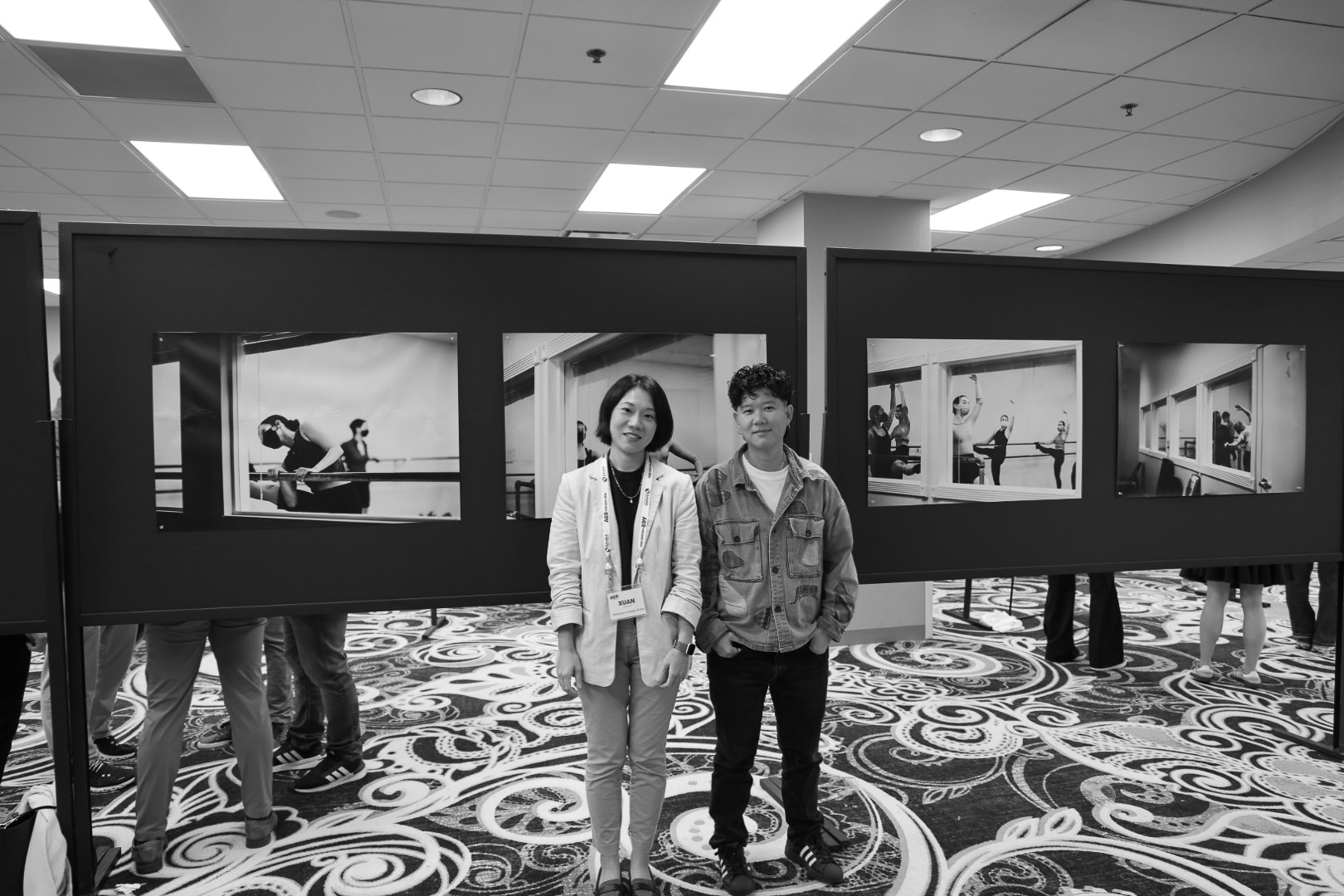
• Wallence Zhou (Independent)
• Xuan Xie (University of Hawaiʻi at Hilo)
This research and art pieces were presented and exhibited at Chicago | ACR 2026, bringing its interdisciplinary inquiry into the relationship between structural constraint, bodily expression, and individual resistance to an academic audience. Integrating photographic practice with critical analysis, the work examines the body as both a site shaped by external restrictions and a medium through which agency and resistance are articulated. Its presentation at Chicago | ACR 2026 situates the project within an ongoing scholarly dialogue at the intersection of visual culture, embodiment, and critical research.
Short Abstract
This work explores the dialectic between structural restriction and individual resistance. By visualizing the body’s struggle against frames and masks, this work illustrates how dancers achieve elevation—moving from physical containment toward aesthetic transcendence. The body thus becomes a site of agency, reclaiming power through the lived, sensory experience of movement.

This series of five high-contrast, monochrome photographs captures rhythmic claustrophobia. Subjects are encased within heavy borders—visual cages that strip away context to expose the body’sraw mechanics. Focus rests on strained anatomy, where void-like shadows and harsh highlights emphasize the mask as both physical barrier and psychological veil. Amidst this confinement, dancers push against the frame with explosive energy, symbolizing the struggle for agency under observation and a spirit seeking elevation.

High-contrast digital monochrome and low-key lighting sculpt the performers' physical strain. Crucially, the "visual cage" is a physical boundary created through a tightly cropped aperture and masking during capture, rather than post-production. This creates a pressurized compositional environment at the moment of creation.
Conceived in July 2022, the series documents a specific cultural moment: MFA dancers in high-intensity rehearsals still bound by institutional mask mandates while the external world slowly reopened. The work captures the visceral struggle for breath—a muffled, rhythmic exertion where the weight of the fabric created a literal barrier to artistic expression.
The first author executed the photography; the research team analyzed the work through a consumer research lens.

This project investigates the liminality of creative expression under physical and institutional constraints. Set within MFA dance rehearsals, it uses observational and ethnographic photography to document the “disciplined body” in crisis. Findings show that institutional resistance does not simply inhibit movement but transforms it. Rather than effortless elevation, movement becomes gritty and labored, where the struggle against gravity and fabric becomes the aesthetic focus. This suggests animportant contribution to consumer research: constraints do not only limit agency but can catalyzenew forms of creativity. By visualizing this friction, the work offers how consumers and creators navigate “forced extensions” of the self, proposing resistance itself as a generative force.

Inspired by Joy and Sherry’s (2003)’s framework of the “disciplined body,” this work explores how institutional and social rules are physically inscribed on the consumer and creator. Here, the mask becomes a tangible instrument of discipline that regulates the body’s most basic functions. The project documents kinetic resistance—the moment when the performer’s drive for agency collides with the “social rules” represented by the mask and the internal border. By framing this struggle, the artwork examines the friction between personal identity and the institutional structuresthat seek to regulate it.

This work enriches consumer research by offering a phenomenological visualization of the“disciplined body” theorized by Joy and Sherry (2003). Rather than depicting the body as a passive vessel of consumption, the images show it as a site of embodied struggle, where dancers resist masks and the “visual cage” of the frame. This tension highlights conflicts between internal agency and institutional mandates. The work also extends Belk’s (1988) concept of the Extended Self by foregrounding its restrictive dimension. The mask and border act as imposed extensions that constrain rather than expand identity. The series thus provides a metaphor for the contemporary consumer experience: negotiating performance and resistance within increasingly structured digital and physical environments.
References
Belk, Russell W. (1988), "Possessions and the Extended Self," Journal of Consumer Research, 15 (2),139–68.
Joy, Annamma, and John F. Sherry Jr. (2003), "Discursive Formations and the Body: An Anthropological Approach to Consumer Culture," Consumption, Markets and Culture, 6 (1), 49–73.


